CUTIE is finishing on this 30th of December, and this is my little celebration of this time together.
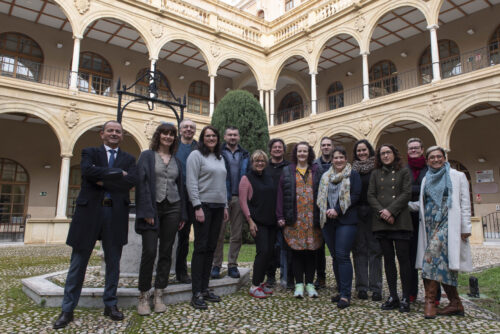 Taking part in the CUTIE project from the University of Murcia has been a deeply enriching experience. Not only because it has allowed us to advance in our understanding and dissemination of Digital Teaching Competence (DTC) and broader educational digital transformation within our institution, but also because it has opened up spaces to talk, reflect and build together from a very practical, close, flexible perspective — always grounded in a strong educational commitment.
The UMU team in CUTIE has been very directly involved in the project’s communication and outreach. From the very beginning, when we first imagined the project, we knew we didn’t want “dissemination” in the traditional sense. What we wanted was to genuinely contribute to the wider conversation about educational digital transformation. That is how this “entity” we called the CUTIE Channel was born: a set of social media profiles (Instagram, LinkedIn, X, Mastodon) together with our CUTIE Podcast, where we ended up producing eight episodes. It has been a part of the work that I particularly loved, because it allowed us to share what we were doing in an open, fresh and approachable way, while also bringing into our conversations the perspectives of experts from all over the world (thank you to all of them). It was never meant to be a showcase, but rather a way of sharing processes, ideas and learning… and, above all, sparking conversation.
Another contribution from Murcia was helping coordinate the use of the CUTE Canvas in both WP2 and WP3 — a conceptual and practical tool inherited from the previous CUTE project (in which I also participated). Although CUTIE has an international, collaborative and complex structure, we have always insisted that educational transformation must be concrete and very local. In Murcia, in addition to the joint project tasks, we focused on developing materials to support a deeper understanding of DTC among different university actors: faculty, students and institutional decision-makers. We were convinced that, to create real impact, we needed to speak to each group from their own starting point, making visible needs that were often not even articulated as such.
This is why a fundamental part of our work at UMU was creating a Spanish version of the course materials, not simply as a translation, but as a deep adaptation: incorporating contextualised references, connecting with the Spanish University Digital Teaching Competence Framework, and including CUTIE materials developed directly in Spanish. We believe these resources not only enrich our own institution but may also serve as inspiration and support for others.
CUTIE has given us the space to pause and think together — from our diverse professional backgrounds — about how we talk about digital competence, how we understand it institutionally, how teachers and students experience it, and what institutional leaders need to foster sustainable transformation processes.
And perhaps what I value most from this experience is something that never appears in official reports: the personal touch — the CUTIE people. It is not often that we get to work with such an extraordinary group of people. Our monthly online meetings and our in-person gatherings became wonderful spaces for learning, professional growth, fun and warm personal connection.
 30I hope everything we have produced from our project can be useful to others. That is, after all, the essence of an ERASMUS project: that what we do in one small corner — in our case, Murcia — might open conversations and support digital transformation processes elsewhere.
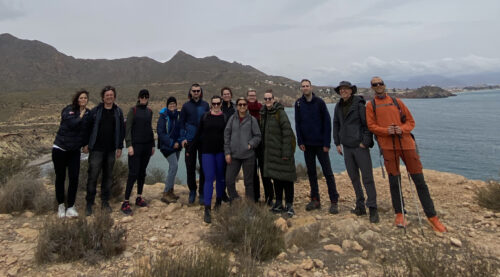
I have learned so much personally, and I will miss the CUTIE people dearly… at least until we meet again. Our path together has taken us from beaches to mountains to castles to snowy landscapes, reminding me that diversity —of places, cultures and ideas— has been CUTIE’s greatest strength. It has been a privilege to walk that path with the CUTIE people.
You can find all the information about the CUTIE project on its website https://cutie.unak.is/, and all the Spanish-language resources developed at UMU on the CUTIE at UMU site https://www.um.es/cute/
 On 30 December 2023, the DALI project -Data Literacy for Citizenship- (